

14-Hydroxylated brassinolide Supporting Scientific Planting and Application Analysis of Typical Crops
A Revolutionary Breakthrough in Scientific Planting
Traditional agriculture's reliance on extensive watering and fertilization is no longer sustainable. Modern planting requires precise intervention, much like traditional Chinese medicine. Plant growth regulators are precisely such an agent—they don't simply and crudely stimulate growth, but rather awaken the crop's own potential by regulating the balance of endogenous hormones.
1. 14-Hydroxylated brassinolide Precisely Regulates Growth Rhythms
Just as human biological clocks need regulation, crops also have their own growth rhythms. 14-Hydroxylated brassinolide can precisely act on each stage of plant growth: promoting root and seedling growth during the seedling stage, protecting flowers and fruits during the flowering stage, and improving quality during fruit enlargement, allowing crops to do the right thing at the right time.
2. 14-Hydroxylated brassinolide Enhances Stress Resistance
Crops treated with regulators exhibit stronger survival capabilities when facing adversities such as drought, waterlogging, and low temperatures. The principle is to activate the expression of stress-resistant genes in plants, which is equivalent to putting "protective armor" on crops.
3.14-Hydroxylated brassinolide Improves Fruit Marketability
The most noticeable changes after application are improved fruit uniformity, brighter color, and increased sugar content. Old Li's tomatoes reached premium fruit standards for the first time last year, and the purchase price doubled.
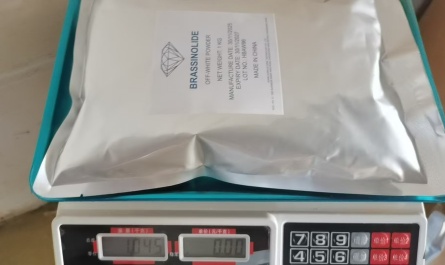
Effects of Applying 14-Hydroxylated brassinolide to Three Typical Crops
1. Fruit Trees: Say Goodbye to Alternating Bearings
Apples, citrus, and other fruit trees often experience alternating high and low yields, known as "alternating bearings." Spraying 14-Hydroxylated brassinolide during the flowering period:
Significantly increases fruit set rate by over 30%
Promotes flower bud differentiation, laying the foundation for next year's fruiting
Reduces physiological fruit drop, ensuring stable yields
2. Vegetables: Overcomes Continuous Cropping Obstacles
Greenhouse vegetables are most vulnerable to seedling death and root rot caused by continuous cropping obstacles. The solutions for 14-Hydroxylated brassinolide are:
Promote root development and enhance nutrient absorption;
Improve plant immunity and reduce soil-borne diseases;
Shorten the recovery period and enable continuous multi-cropping.
3. Field Crops: Resisting Extreme Weather
Staple crops such as wheat and rice face the greatest climate risks. Practical application of 14-Hydroxylated brassinolide has proven that:
* Application during the heading stage can reduce damage from hot, dry winds.
* Application during the grain-filling stage can increase the thousand-grain weight.
* Application throughout the entire growth period can increase yield by 8-15%.

The Golden Rules for Safe Use of 14-Hydroxylated Brassinolide
* Any agricultural input requires scientific application, and plant growth regulators are no exception.
Through years of practice, we have summarized three principles:
1. Timeliness Principle
Different crops have their own "critical windows." For example, grapes should be sprayed twice, once 7 days before flowering and once after flowering, while tomatoes need to be applied during the initial flowering stage and the fruit enlargement stage.
2. Appropriate Dosage Principle
Strictly follow the recommended concentration. It is better to apply small amounts frequently than to apply too much at once. A dilution ratio of 2000-3000 times is generally recommended.
3. Appropriate Application Principle:
Foliar spraying should be even and thorough, moistening both sides of the leaves without dripping. It is best to apply the pesticide on a windless, sunny day before 10:00 AM or after 4:00 PM.
Traditional agriculture's reliance on extensive watering and fertilization is no longer sustainable. Modern planting requires precise intervention, much like traditional Chinese medicine. Plant growth regulators are precisely such an agent—they don't simply and crudely stimulate growth, but rather awaken the crop's own potential by regulating the balance of endogenous hormones.
1. 14-Hydroxylated brassinolide Precisely Regulates Growth Rhythms
Just as human biological clocks need regulation, crops also have their own growth rhythms. 14-Hydroxylated brassinolide can precisely act on each stage of plant growth: promoting root and seedling growth during the seedling stage, protecting flowers and fruits during the flowering stage, and improving quality during fruit enlargement, allowing crops to do the right thing at the right time.
2. 14-Hydroxylated brassinolide Enhances Stress Resistance
Crops treated with regulators exhibit stronger survival capabilities when facing adversities such as drought, waterlogging, and low temperatures. The principle is to activate the expression of stress-resistant genes in plants, which is equivalent to putting "protective armor" on crops.
3.14-Hydroxylated brassinolide Improves Fruit Marketability
The most noticeable changes after application are improved fruit uniformity, brighter color, and increased sugar content. Old Li's tomatoes reached premium fruit standards for the first time last year, and the purchase price doubled.
Effects of Applying 14-Hydroxylated brassinolide to Three Typical Crops
1. Fruit Trees: Say Goodbye to Alternating Bearings
Apples, citrus, and other fruit trees often experience alternating high and low yields, known as "alternating bearings." Spraying 14-Hydroxylated brassinolide during the flowering period:
Significantly increases fruit set rate by over 30%
Promotes flower bud differentiation, laying the foundation for next year's fruiting
Reduces physiological fruit drop, ensuring stable yields
2. Vegetables: Overcomes Continuous Cropping Obstacles
Greenhouse vegetables are most vulnerable to seedling death and root rot caused by continuous cropping obstacles. The solutions for 14-Hydroxylated brassinolide are:
Promote root development and enhance nutrient absorption;
Improve plant immunity and reduce soil-borne diseases;
Shorten the recovery period and enable continuous multi-cropping.
3. Field Crops: Resisting Extreme Weather
Staple crops such as wheat and rice face the greatest climate risks. Practical application of 14-Hydroxylated brassinolide has proven that:
* Application during the heading stage can reduce damage from hot, dry winds.
* Application during the grain-filling stage can increase the thousand-grain weight.
* Application throughout the entire growth period can increase yield by 8-15%.
The Golden Rules for Safe Use of 14-Hydroxylated Brassinolide
* Any agricultural input requires scientific application, and plant growth regulators are no exception.
Through years of practice, we have summarized three principles:
1. Timeliness Principle
Different crops have their own "critical windows." For example, grapes should be sprayed twice, once 7 days before flowering and once after flowering, while tomatoes need to be applied during the initial flowering stage and the fruit enlargement stage.
2. Appropriate Dosage Principle
Strictly follow the recommended concentration. It is better to apply small amounts frequently than to apply too much at once. A dilution ratio of 2000-3000 times is generally recommended.
3. Appropriate Application Principle:
Foliar spraying should be even and thorough, moistening both sides of the leaves without dripping. It is best to apply the pesticide on a windless, sunny day before 10:00 AM or after 4:00 PM.
RECENT POSTS
-
What is the purpose of COA (Certificate of Analysis) verification for plant growth regulators?
-
How do you evaluate the effectiveness of plant growth regulators?
-
Preparation and Application Protocol for Gibberellic Acid GA3 90% TC to Break Dormancy and Promote Rooting and Germination
-
Precise Dilution and Application Guidelines for Diethyl Aminoethyl Hexanoate DA-6 98% TC
Featured News