

How Do Fibrous Roots Develop?
Root systems play a pivotal role in plant growth; consequently, the process of root formation is an indispensable topic in agriculture.
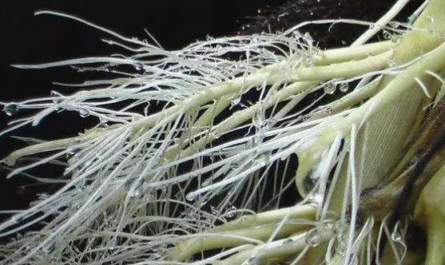
Plant root systems are generally categorized into two major types: taproot systems and fibrous root systems. Spanning from the southern to the northern regions, major staple crops—such as wheat, rice, and maize—predominantly possess fibrous root systems.
Fibrous roots represent the typical root morphology found in monocotyledonous plants. Shortly after seed germination, the primary root undergoes degeneration; subsequently, adventitious roots emerge from beneath the hypocotyl or from the base of the young stem—these are known as fibrous roots. We selected maize—a representative example of a fibrous-rooted crop—to evaluate the efficacy of Pinsoa’s flagship product for promoting fibrous root growth: INDOLE-3-BUTYRIC ACID POTASSIUM SALT (IBA-K).
The results following the application of IBA-K via fertigation are illustrated below:
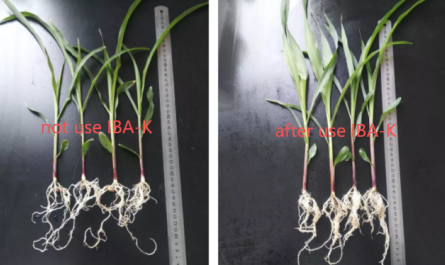
1. The treatment group exhibited a more extensive root system and longer individual root strands compared to the control group.
2. In the control group, the stem fresh weight was 13.1 g, and the root fresh weight was 6.5 g.
3. In the experimental group, the stem fresh weight was 17.2 g, and the root fresh weight was 8.1 g.
These results demonstrate that maize seedlings treated with IBA-K are more robust, featuring thicker stems and greener leaves. Furthermore, they develop a more abundant and elongated root system, with both the total plant fresh weight and the root fresh weight significantly surpassing those of the control group.
About Pinsoa IBA-K
Pinsoa IBA-K presents as a white crystalline solid that is readily soluble in water and soluble in organic solvents such as acetone, ethanol, and diethyl ether. It exhibits higher biological activity than indole-3-butyric acid (IBA) itself; however, as it undergoes slow decomposition when exposed to strong light, storage in a light-proof environment is recommended. This product is easily absorbed and utilized by crops, concentrating specifically at the growth points to stimulate cell division. It effectively induces the formation of adventitious roots, resulting in a root system characterized by high density, straight growth, increased thickness, and an abundance of root hairs. Common application methods include root dipping, soaking, fertigation, and seed dressing.
Plant root systems are generally categorized into two major types: taproot systems and fibrous root systems. Spanning from the southern to the northern regions, major staple crops—such as wheat, rice, and maize—predominantly possess fibrous root systems.
Fibrous roots represent the typical root morphology found in monocotyledonous plants. Shortly after seed germination, the primary root undergoes degeneration; subsequently, adventitious roots emerge from beneath the hypocotyl or from the base of the young stem—these are known as fibrous roots. We selected maize—a representative example of a fibrous-rooted crop—to evaluate the efficacy of Pinsoa’s flagship product for promoting fibrous root growth: INDOLE-3-BUTYRIC ACID POTASSIUM SALT (IBA-K).
The results following the application of IBA-K via fertigation are illustrated below:
1. The treatment group exhibited a more extensive root system and longer individual root strands compared to the control group.
2. In the control group, the stem fresh weight was 13.1 g, and the root fresh weight was 6.5 g.
3. In the experimental group, the stem fresh weight was 17.2 g, and the root fresh weight was 8.1 g.
These results demonstrate that maize seedlings treated with IBA-K are more robust, featuring thicker stems and greener leaves. Furthermore, they develop a more abundant and elongated root system, with both the total plant fresh weight and the root fresh weight significantly surpassing those of the control group.
About Pinsoa IBA-K
Pinsoa IBA-K presents as a white crystalline solid that is readily soluble in water and soluble in organic solvents such as acetone, ethanol, and diethyl ether. It exhibits higher biological activity than indole-3-butyric acid (IBA) itself; however, as it undergoes slow decomposition when exposed to strong light, storage in a light-proof environment is recommended. This product is easily absorbed and utilized by crops, concentrating specifically at the growth points to stimulate cell division. It effectively induces the formation of adventitious roots, resulting in a root system characterized by high density, straight growth, increased thickness, and an abundance of root hairs. Common application methods include root dipping, soaking, fertigation, and seed dressing.