

Key Focus Areas for Autumn and Winter Fruit Tree Management
Autumn and winter management is a crucial phase in fruit tree care and a necessary measure to ensure healthy growth and fruit production in the coming year.
I. Fertilization
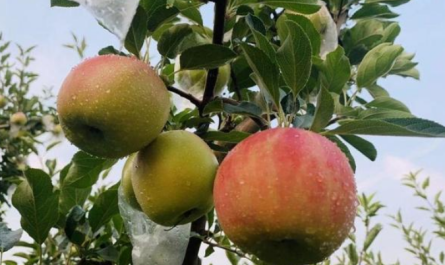
Base fertilizer serves as the primary source of nutrients for fruit trees over an extended period of the year; therefore, it must be applied in sufficient quantities. It typically consists mainly of slow-release organic fertilizers (such as human and animal manure, green manure, fresh grass, and crop stalks) supplemented with phosphate fertilizer (commonly superphosphate) and a small amount of quick-acting nitrogen fertilizer. The optimal time for applying base fertilizer is autumn—specifically, immediately after fruit harvest—as earlier application is preferable to later. Application methods include circular trenching, radial trenching, and strip trenching, which should be alternated annually.
II. Irrigation
After applying base fertilizer in the autumn, the trees should be watered once to prepare them for winter (winter irrigation) before the soil freezes.
III. Trunk Whitewashing
Whitewashing tree trunks helps prevent frost damage and controls pests and diseases that overwinter on the bark. The whitewash mixture is primarily lime-based, with appropriate amounts of salt and pig blood added; small amounts of yellow clay may also be included.
IV. Shaping and Pruning
Pruning—particularly winter pruning—is a primary management measure. Techniques such as heading back (shortening), thinning, renewal pruning (cutting back to older wood), leaving shoots unpruned (letting them grow freely), wounding, bending, propping, and pulling down branches should be applied flexibly. The goal is to maintain a defined structure without being overly rigid, and to avoid disorder while ensuring a stable, sturdy framework and appropriate branch distribution.
For mature trees, care should be taken to preserve the leading tips of scaffold branches and to prune fruiting branch groups rationally. The aim is to achieve a three-dimensional fruiting pattern—sparse at the top and dense at the bottom, sparse on the sunny side and dense on the shady side, and sparse on the inside while dense on the outside—thereby ensuring good ventilation and light penetration. Crossing, overlapping, drooping, and diseased or pest-infested branches should be appropriately thinned or cut back. When pruning trees that have been left unpruned and allowed to grow naturally for years, take a comprehensive approach to reshaping the tree. Fully utilize techniques such as propping and pulling to widen the angles of major branches, and perform appropriate thinning and heading-back cuts, focusing on improving ventilation and light penetration as well as renewing and cultivating fruiting branch groups. Avoid excessive thinning that reduces a large tree to a small one, and prevent creating "opposing wounds" (wounds directly opposite each other) or "girdling wounds" (wounds encircling the branch or trunk) on the central leader.
 V. Pest and Disease Control
(1) Prune out branches affected by pests or diseases in conjunction with general pruning. Promptly remove dead leaves and diseased fruit remaining on the tree, as well as binding materials like fruit-support strings, to eliminate overwintering sites for pests and pathogens. Scrape off old, loose bark from the tree and burn the debris.
(2) Promptly scrape off any disease lesions found on the fruit trees. Collect the scraped-off diseased tissue and burn it.
I. Fertilization
Base fertilizer serves as the primary source of nutrients for fruit trees over an extended period of the year; therefore, it must be applied in sufficient quantities. It typically consists mainly of slow-release organic fertilizers (such as human and animal manure, green manure, fresh grass, and crop stalks) supplemented with phosphate fertilizer (commonly superphosphate) and a small amount of quick-acting nitrogen fertilizer. The optimal time for applying base fertilizer is autumn—specifically, immediately after fruit harvest—as earlier application is preferable to later. Application methods include circular trenching, radial trenching, and strip trenching, which should be alternated annually.
II. Irrigation
After applying base fertilizer in the autumn, the trees should be watered once to prepare them for winter (winter irrigation) before the soil freezes.
III. Trunk Whitewashing
Whitewashing tree trunks helps prevent frost damage and controls pests and diseases that overwinter on the bark. The whitewash mixture is primarily lime-based, with appropriate amounts of salt and pig blood added; small amounts of yellow clay may also be included.
IV. Shaping and Pruning
Pruning—particularly winter pruning—is a primary management measure. Techniques such as heading back (shortening), thinning, renewal pruning (cutting back to older wood), leaving shoots unpruned (letting them grow freely), wounding, bending, propping, and pulling down branches should be applied flexibly. The goal is to maintain a defined structure without being overly rigid, and to avoid disorder while ensuring a stable, sturdy framework and appropriate branch distribution.
For mature trees, care should be taken to preserve the leading tips of scaffold branches and to prune fruiting branch groups rationally. The aim is to achieve a three-dimensional fruiting pattern—sparse at the top and dense at the bottom, sparse on the sunny side and dense on the shady side, and sparse on the inside while dense on the outside—thereby ensuring good ventilation and light penetration. Crossing, overlapping, drooping, and diseased or pest-infested branches should be appropriately thinned or cut back. When pruning trees that have been left unpruned and allowed to grow naturally for years, take a comprehensive approach to reshaping the tree. Fully utilize techniques such as propping and pulling to widen the angles of major branches, and perform appropriate thinning and heading-back cuts, focusing on improving ventilation and light penetration as well as renewing and cultivating fruiting branch groups. Avoid excessive thinning that reduces a large tree to a small one, and prevent creating "opposing wounds" (wounds directly opposite each other) or "girdling wounds" (wounds encircling the branch or trunk) on the central leader.
V. Pest and Disease Control(1) Prune out branches affected by pests or diseases in conjunction with general pruning. Promptly remove dead leaves and diseased fruit remaining on the tree, as well as binding materials like fruit-support strings, to eliminate overwintering sites for pests and pathogens. Scrape off old, loose bark from the tree and burn the debris.
(2) Promptly scrape off any disease lesions found on the fruit trees. Collect the scraped-off diseased tissue and burn it.
RECENT POSTS
-
13th National Plant Growth Regulator Industry Conference Held in Hebi Henan
-
Key Innovation Directions for Plant Hormone Technologies
-
Latest Growth Forecast for the Southeast Asian Plant Growth Regulator Market
-
Experiments have demonstrated excellent results using the plant hormone "Pineapple King" in Vietnamese pineapple cultivation
Featured News