

Application of Plant Growth Regulators in Fruit Trees - Walnut
01. Walnut Branch Growth and Development
Walnut trees grow vigorously but enter the fruiting period relatively late. Generally, it takes 7-10 years for seedlings planted from seed to enter the fruiting period, and 3-5 years for grafted seedlings. In walnut-growing areas, especially on flat land along mountains, due to the thick and fertile soil, trees easily grow vigorously year after year, producing only trees without fruit.
One-year-old walnut branches can be divided into three types: vegetative branches, fruiting branches, and male flower branches. Vegetative branches are branches that only bear leaves and cannot flower or bear fruit. Based on their length, they can be divided into short branches, medium branches, and long branches. Fruiting branches develop from mixed buds on fruiting mother branches. Male flower branches are weak branches that only bear male flower buds; only the terminal bud is a vegetative bud, and it is difficult for mixed buds to form. The growth of walnut branches is affected by age, nutritional status, location, and site conditions. Generally, young trees and strong branches can have two growth cycles per year, forming spring and autumn shoots. Secondary growth weakens with age. Generally, excessive secondary growth leads to poor lignification, depletes tree nutrients, and hinders branch overwintering.
Appropriately suppressing vegetative growth and promoting reproductive growth using growth regulators is of significant practical importance in production.
Technical Measures for Controlling Vegetative Growth and Promoting Fruiting:
01. Paclobutrazol:
For trees with excessive vigor and insufficient male flowers, apply 15% Paclobutrazol (Paclo) wettable powder to the soil in April or September, at a rate of 2-3g per square meter of canopy projection area; or spray with a 150-fold dilution of 15% Paclobutrazol 2-3 times from June to September. This effectively suppresses vegetative growth.
02. Chlormequat Chloride:
Chlormequat has a significant effect on the growth of new branches in walnut trees. For suppressing vegetative growth, a concentration of 200mg/L is recommended. Strict concentration control is essential during application, as excessively high concentrations can impair photosynthesis. In addition, while Chlormequat Chloride can improve fruit set rate when used as a fruit-setting agent, it reduces fruit quality. In actual production, it can be considered to use it in combination with boric acid, which can improve fruit set rate and increase yield without reducing fruit quality.
03 Ethephon
Spraying 500-1500 mg/L Ethephon twice at 15-day intervals during the early stage of shoot growth can reduce the height of young walnut trees and promote early fruiting. Spraying with 1500 mg/L Ethephon is most effective.
04 1-Naphthyl Acetic Acid (NAA)
Applying 50-125 mg/L NAA to the trunk during the flowering period can improve fruit set rate to varying degrees. Experiments showed that applying a 75 mg/L concentration to the trunk increased the fruit set rate by an average of over 33% over four years.
Promoting Fruit Maturation and Peeling
01. Characteristics of Walnut Fruit Maturation
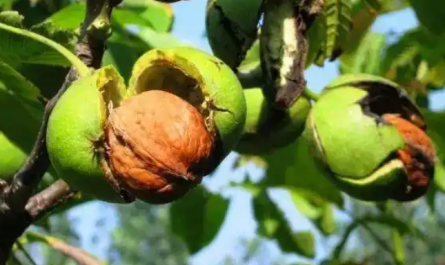
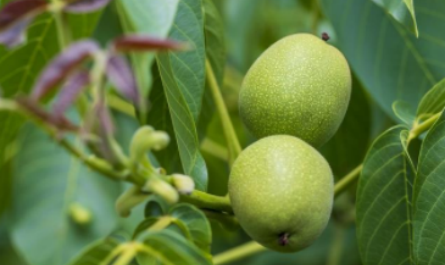
Timely harvesting is a crucial step in walnut production. Only timely harvesting can achieve the goal of high-quality and high-yield walnuts. Walnut fruits are enclosed by a husk, inside which lies a hard shell (walnut shell) and kernel. The husk and kernel mature at different times; the kernel often matures first, followed by the husk. Walnuts must reach full maturity before harvesting. Harvesting too early makes the husk difficult to peel, the kernel underdeveloped, resulting in a low kernel yield and low oil extraction rate during processing, and the nuts are not suitable for storage. Harvesting too late causes the fruit to easily fall off, and the fruit remains on the tree for too long after the husk has cracked, increasing the chance of mold infection and leading to a decline in nut quality. The signs of walnut fruit maturity are that the husk changes from dark green to light yellow, 30% of the fruit has cracked at the top, 30% of the husk is easily peeled off, and some fruits fall off. At this time, the walnut kernel is full, the embryo is mature, the cotyledons have hardened, and the flavor is rich and fragrant, indicating the optimal harvesting time. Therefore, during the near-ripe stage of walnuts, it is important to observe their development to ensure timely harvesting. The ripening period of walnuts varies depending on the variety and climatic conditions, and the specific harvesting period should be determined based on various factors affecting the timing of walnut ripening.
The changes in respiration rate, ethylene release, and the content of endogenous hormones IAA, ABA, GA3, ZR, and Z (zeatin) during walnut fruit ripening were measured. The results showed that, except for a higher Z content in the kernel, the levels of other hormones in the green husk were higher than those in the kernel. As the fruit ripened, the contents of IAA, GA3, Z, ZR, and ethylene release all showed a decreasing trend, while the ABA content in the green husk gradually increased. After fruit ripening, the contents of GA3 in the green husk and Z in the kernel increased significantly, and the ethylene release from the fruit increased significantly, with a more rapid increase in ethylene release after harvest. The study confirmed that the changes in respiration rate and ethylene release were basically the same, and the respiration rate of fruits treated with ethephon after harvest increased significantly.
02. Technical Measures to Promote Fruit Ripening and Peeling
(1) Ethephon
When a few walnut fruits crack, spray with 500-1000 mg/L Ethephon (with 0.1%-0.2% laundry detergent as an adhesive). After 3 days, the fruit peel turns yellowish-green, and after 6-7 days, more than 95% of the fruits crack, allowing for harvesting 14-15 days earlier. However, this causes earlier leaf drop, which is detrimental to flowering and fruit setting the following year.
Spray with 500-2000 mg/L Ethephon 10-20 days before walnut harvest to form an abscission layer on the fruit stalk, causing the green peel to crack. Then, use mechanical vibration to shake the trunk, causing the fruit to fall to the ground. The advantage of this method is that the green peel is easy to peel off, and the fruit surface is less contaminated. However, thin-shelled walnuts can only be harvested manually, and the use of ethephon spraying on the trees for ripening often leads to severe leaf drop. Studies suggest that spraying the trees with a mixture of 125 mg/L Ethephon and 250 mg/L (or 500 mg/L) NAA 2-3 weeks before harvest can achieve a 100% cracking rate of the green husk while reducing the leaf drop rate to only about 20%, similar to the leaf drop rate during normal manual harvesting, thus providing new evidence for walnut harvesting.
After harvesting, soaking or dipping the harvested mature walnuts in 0.3%–0.5% Ethephon solution yields excellent results in removing the green husk, with a peel rate exceeding 95%. Alternatively, after harvesting, place the picked fruit in a well-ventilated area and spray the green-skinned fruit with a 3000–5000 mg/L Ethephon solution, stirring thoroughly to ensure even coating. Under conditions of 30℃ and 80%–90% relative humidity, the peel rate reaches over 95% in 3–4 days. The ripening time and concentration of Ethephon are related to the fruit's maturity. Higher fruit maturity requires lower concentrations and shorter ripening times.
Walnut trees grow vigorously but enter the fruiting period relatively late. Generally, it takes 7-10 years for seedlings planted from seed to enter the fruiting period, and 3-5 years for grafted seedlings. In walnut-growing areas, especially on flat land along mountains, due to the thick and fertile soil, trees easily grow vigorously year after year, producing only trees without fruit.
One-year-old walnut branches can be divided into three types: vegetative branches, fruiting branches, and male flower branches. Vegetative branches are branches that only bear leaves and cannot flower or bear fruit. Based on their length, they can be divided into short branches, medium branches, and long branches. Fruiting branches develop from mixed buds on fruiting mother branches. Male flower branches are weak branches that only bear male flower buds; only the terminal bud is a vegetative bud, and it is difficult for mixed buds to form. The growth of walnut branches is affected by age, nutritional status, location, and site conditions. Generally, young trees and strong branches can have two growth cycles per year, forming spring and autumn shoots. Secondary growth weakens with age. Generally, excessive secondary growth leads to poor lignification, depletes tree nutrients, and hinders branch overwintering.
Appropriately suppressing vegetative growth and promoting reproductive growth using growth regulators is of significant practical importance in production.
Technical Measures for Controlling Vegetative Growth and Promoting Fruiting:
01. Paclobutrazol:
For trees with excessive vigor and insufficient male flowers, apply 15% Paclobutrazol (Paclo) wettable powder to the soil in April or September, at a rate of 2-3g per square meter of canopy projection area; or spray with a 150-fold dilution of 15% Paclobutrazol 2-3 times from June to September. This effectively suppresses vegetative growth.
02. Chlormequat Chloride:
Chlormequat has a significant effect on the growth of new branches in walnut trees. For suppressing vegetative growth, a concentration of 200mg/L is recommended. Strict concentration control is essential during application, as excessively high concentrations can impair photosynthesis. In addition, while Chlormequat Chloride can improve fruit set rate when used as a fruit-setting agent, it reduces fruit quality. In actual production, it can be considered to use it in combination with boric acid, which can improve fruit set rate and increase yield without reducing fruit quality.
03 Ethephon
Spraying 500-1500 mg/L Ethephon twice at 15-day intervals during the early stage of shoot growth can reduce the height of young walnut trees and promote early fruiting. Spraying with 1500 mg/L Ethephon is most effective.
04 1-Naphthyl Acetic Acid (NAA)
Applying 50-125 mg/L NAA to the trunk during the flowering period can improve fruit set rate to varying degrees. Experiments showed that applying a 75 mg/L concentration to the trunk increased the fruit set rate by an average of over 33% over four years.
Promoting Fruit Maturation and Peeling
01. Characteristics of Walnut Fruit Maturation
Timely harvesting is a crucial step in walnut production. Only timely harvesting can achieve the goal of high-quality and high-yield walnuts. Walnut fruits are enclosed by a husk, inside which lies a hard shell (walnut shell) and kernel. The husk and kernel mature at different times; the kernel often matures first, followed by the husk. Walnuts must reach full maturity before harvesting. Harvesting too early makes the husk difficult to peel, the kernel underdeveloped, resulting in a low kernel yield and low oil extraction rate during processing, and the nuts are not suitable for storage. Harvesting too late causes the fruit to easily fall off, and the fruit remains on the tree for too long after the husk has cracked, increasing the chance of mold infection and leading to a decline in nut quality. The signs of walnut fruit maturity are that the husk changes from dark green to light yellow, 30% of the fruit has cracked at the top, 30% of the husk is easily peeled off, and some fruits fall off. At this time, the walnut kernel is full, the embryo is mature, the cotyledons have hardened, and the flavor is rich and fragrant, indicating the optimal harvesting time. Therefore, during the near-ripe stage of walnuts, it is important to observe their development to ensure timely harvesting. The ripening period of walnuts varies depending on the variety and climatic conditions, and the specific harvesting period should be determined based on various factors affecting the timing of walnut ripening.
The changes in respiration rate, ethylene release, and the content of endogenous hormones IAA, ABA, GA3, ZR, and Z (zeatin) during walnut fruit ripening were measured. The results showed that, except for a higher Z content in the kernel, the levels of other hormones in the green husk were higher than those in the kernel. As the fruit ripened, the contents of IAA, GA3, Z, ZR, and ethylene release all showed a decreasing trend, while the ABA content in the green husk gradually increased. After fruit ripening, the contents of GA3 in the green husk and Z in the kernel increased significantly, and the ethylene release from the fruit increased significantly, with a more rapid increase in ethylene release after harvest. The study confirmed that the changes in respiration rate and ethylene release were basically the same, and the respiration rate of fruits treated with ethephon after harvest increased significantly.
02. Technical Measures to Promote Fruit Ripening and Peeling
(1) Ethephon
When a few walnut fruits crack, spray with 500-1000 mg/L Ethephon (with 0.1%-0.2% laundry detergent as an adhesive). After 3 days, the fruit peel turns yellowish-green, and after 6-7 days, more than 95% of the fruits crack, allowing for harvesting 14-15 days earlier. However, this causes earlier leaf drop, which is detrimental to flowering and fruit setting the following year.
Spray with 500-2000 mg/L Ethephon 10-20 days before walnut harvest to form an abscission layer on the fruit stalk, causing the green peel to crack. Then, use mechanical vibration to shake the trunk, causing the fruit to fall to the ground. The advantage of this method is that the green peel is easy to peel off, and the fruit surface is less contaminated. However, thin-shelled walnuts can only be harvested manually, and the use of ethephon spraying on the trees for ripening often leads to severe leaf drop. Studies suggest that spraying the trees with a mixture of 125 mg/L Ethephon and 250 mg/L (or 500 mg/L) NAA 2-3 weeks before harvest can achieve a 100% cracking rate of the green husk while reducing the leaf drop rate to only about 20%, similar to the leaf drop rate during normal manual harvesting, thus providing new evidence for walnut harvesting.
After harvesting, soaking or dipping the harvested mature walnuts in 0.3%–0.5% Ethephon solution yields excellent results in removing the green husk, with a peel rate exceeding 95%. Alternatively, after harvesting, place the picked fruit in a well-ventilated area and spray the green-skinned fruit with a 3000–5000 mg/L Ethephon solution, stirring thoroughly to ensure even coating. Under conditions of 30℃ and 80%–90% relative humidity, the peel rate reaches over 95% in 3–4 days. The ripening time and concentration of Ethephon are related to the fruit's maturity. Higher fruit maturity requires lower concentrations and shorter ripening times.
RECENT POSTS
-
What is the purpose of COA (Certificate of Analysis) verification for plant growth regulators?
-
How do you evaluate the effectiveness of plant growth regulators?
-
Preparation and Application Protocol for Gibberellic Acid GA3 90% TC to Break Dormancy and Promote Rooting and Germination
-
Precise Dilution and Application Guidelines for Diethyl Aminoethyl Hexanoate DA-6 98% TC
Featured News